Suspension, Wheel Bearing and Drive Shafts
Form Number: DVT 927
Issue: 6
Origin: DVT
Review: Jan 2028
Information
How To Inspect
The inspections under this sub-section are to be carried out with the vehicle over a pit or on a raised hoist.
Inspecting Suspension Components
The inspection of the suspension components described in sub-section “Suspension – General (G)” suspension arms and linkages, sub-frames, etc, can be carried out in conjunction with this sub-section.
Method Of Inspection
A. Suspension Joints And Wheel Bearings
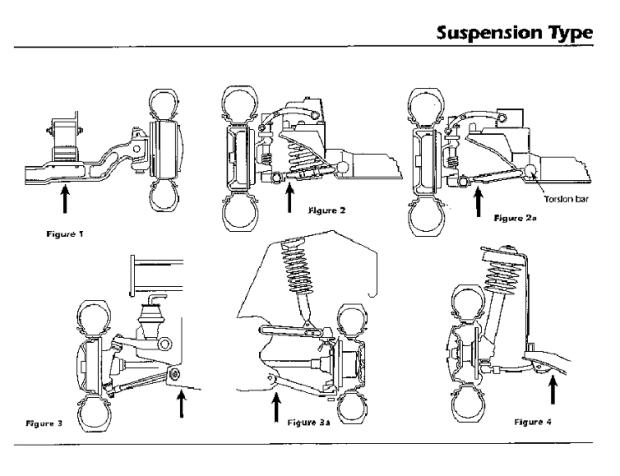
- See diagrams at end of this section for the jacking positions of various suspension types
Jack up the vehicles with suspension type 1, 2 or 2a, so that the wheels are clear of the ground.
Note: Observe relative vertical movement between components during jacking up and lowering vehicle. It may be necessary to carry out the following examinations by placing a suitable bar under each wheel in turn and levering upwards.
a. For suspension types fig 1, check for excessive vertical movement between stub axles and axle beams.
b. For suspension types, fig 2 and 2a, check for vertical movement between swivel and housing, and movement in wishbone bearings.
Note: It is important that fig 2 and 2a type suspensions are jacked so that the suspension spring force is removed from the ball joints, i.e., suspension arms must be clear of their stops. Failure to do this can result in defective joints being missed.
c. For suspension types as fig 3, 3a and 4 it is not necessary to use the axle jack provided the wheel free lift can be used to conduct the lower body inspection. Check for movement in suspension ball joints, tie bar joints and MacPherson strut upper attachments by use of the play detector plates.
- With the wheels clear of the ground, spin each wheel in turn and listen for any sound indicating roughness in the bearing. Also check for tightness in the bearings.
- Lower the road wheels onto Play detector plates, when initial contact is made with the plates (little or no weight on plates) operate the Play detector plates. This is very important for suspension types 1, 2 and 2a. After examination of suspension components, further lower the vehicle until most or all of the vehicle weight is on the play detector plates, operate the plates again and examine all components.
Check:
a. The amount of movement between the stub axle and the axle beam, or
b. The movement in the swivel joints, and the security of their attachment to the stub axle and suspension arms.
c. For play in upper and lower suspension ball joints and wishbone/track control arm bearings,
d. For play
• at MacPherson strut sliding bushes and glands,
• at MacPherson strut upper support bearings. This should also be checked when inspecting steering components on lock to lock.
e. The movement of the wheel relative to the stub axle, and note the amount of play in the wheel bearings.
Note: Suspension ball joints can have free play lift as a feature of their design.
- Examine the condition of the bonding between the metal and flexible material in the MacPherson strut upper support bearing. If visible.
- Check the presence and effectiveness of the suspension retaining and locking devices.
Note: It is not always possible to determine the ‘effectiveness’ of some types of locking device by normal test methods, e.g., self-locking nuts. Only the presence of these devices is a test requirement.
- Check the condition of the axle beam and stub axles.
B. Drive Shafts And Coupling
Inspect as follows while the wheels are jacked up.
- With the vehicle in neutral gear, rotate the wheels when they are on each lock in turn, and check visually the gaiters of the outer constant velocity joints while the pleats are expanded.
Check:
a. The wheel drive shafts for straightness and damage,
b. Drive shaft couplings condition and security.
c. For wear in drive shaft support bearings
Reason For Rejection
Suspension Joints and Wheel Bearings
| Reason for Rejection | Deficiency Category | ||
|---|---|---|---|
| 1 | Excessive Movement: | ||
| a | between a stub axle and an axle beam. Note: Some vehicles (especially with ball thrust races) are designed to have a small amount of vertical movement. | MAJOR | |
| b | between a swivel joint and its housing. | MAJOR | |
| c | at a tie bar joint or wishbone bearing pin or bush, | MAJOR | |
| d | at a MacPherson strut upper attachment. | MAJOR |
Note: Some MacPherson strut top bushes are designed to have lateral play when the suspension is hanging free. Rejection is only justified when play is due to wear and/or maladjustment, etc.
| Reason for Rejection | Deficiency Category | |
|---|---|---|
| 2 | Excessive play, roughness, or tightness in a wheel bearing. | MAJOR |
| 3 | King pin loose in axle beam or its pin retaining device missing, | MAJOR |
| 4 | A swivel joint insecure in a suspension arm or in a stub axle | MAJOR |
| 5 | Excessive play in king pin and/or bush such that it is likely to adversely affect the steering of the vehicle. | MAJOR |
| 6 | Excessive play in a suspension swivel pin or ball joint, | MAJOR |
| 7 | A ball joint securing nut not tight or not locked, | MAJOR |
| 8 | Excessive play in an upper or lower wishbone inner pin or bush | MAJOR |
| 9 | Excessive play in a MacPherson strut sliding bush or gland, | MAJOR |
| 10 | Excessive movement in a MacPherson strut upper support bearing assembly, | MAJOR |
| 11 | Roughness or stiffness in a MacPherson strut upper support bearing (cross check with sub-section ‘Steering Systems’). | MAJOR |
| 12 | A serious deterioration of the bonding between metal and flexible material of an upper support bearing of a MacPherson strut. | MAJOR |
| 13 | A loose or insecurely locked unit in the upper support bearing assembly of a MacPherson strut | MAJOR |
| 14 | A suspension retaining or locking device missing or ineffective. | MAJOR |
| 15 | A cracked, distorted or inappropriately repaired or modified axle beam or stub axle. | MAJOR |
Drive Shafts And Coupling
| Reason for Rejection | Deficiency Category | ||
|---|---|---|---|
| 1 | a | A constant velocity joint gaiter damaged, deteriorated. | MINOR |
| b | A constant velocity joint gaiter missing or excessively damaged, deteriorated or insecure to the extent that it would no longer prevent the ingress of dirt etc. | MAJOR | |
| c | A drive shaft constant velocity joint excessively worn or insecure, | MAJOR | |
| d | A drive shaft coupling excessively worn or insecure, | MAJOR | |
| e | A drive shaft flexible rubber or fabric coupling unit severely cracked or breaking up, | MAJOR | |
| f | A drive shaft flexible rubber or fabric coupling softened by oil contamination, insecure or fouling any other part of the vehicle. | MAJOR | |
| 2 | a | A drive shaft bent or damaged, | MAJOR |
| b | An insecure or fractured fastener securing a drive shaft coupling bearing. | MAJOR | |
| c | A drive shaft support bearing excessively worn | MAJOR |