Appendix A - Structural integrity and corrosion
Form Number: DVT 938
Issue: 6
Origin: DVT
Review: Jan 2028
Introduction
The effect of corrosion on the safety of a vehicle depends on:
- Its extent,
- The function of the section on which it has occurred.
A small amount of corrosion on an important part of a vehicle structure can make a vehicle unsafe where it destroys the continuity of the load bearing structure.
On the other hand, heavy corrosion of unimportant sections may have no effect on the vehicle’s safety.
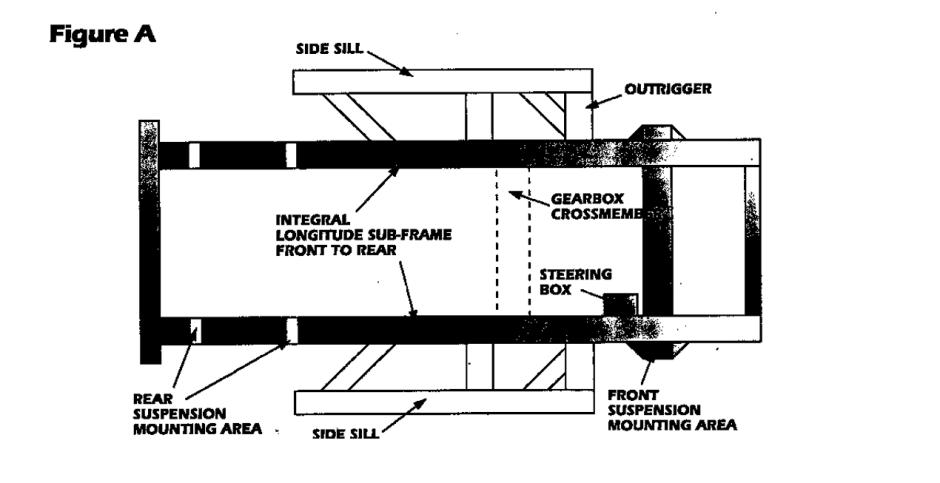
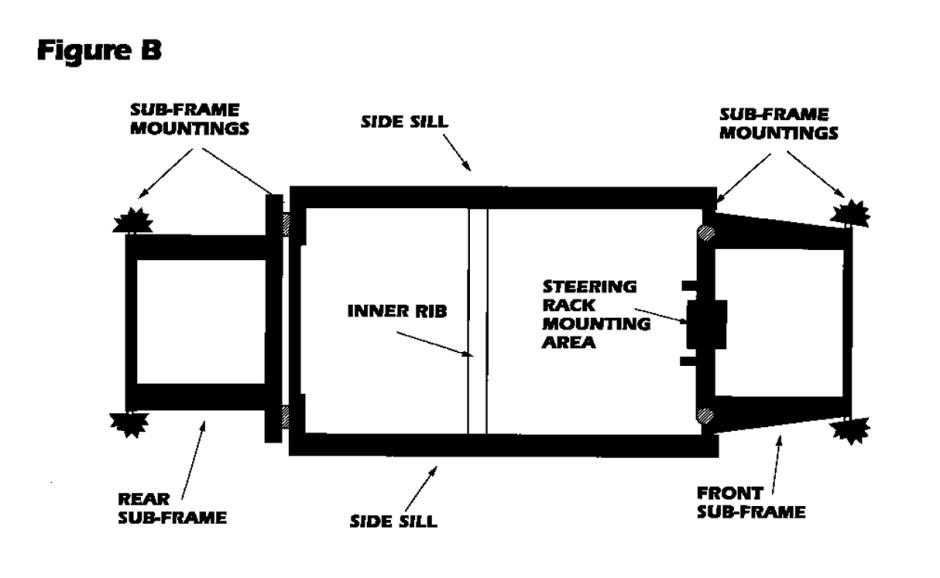
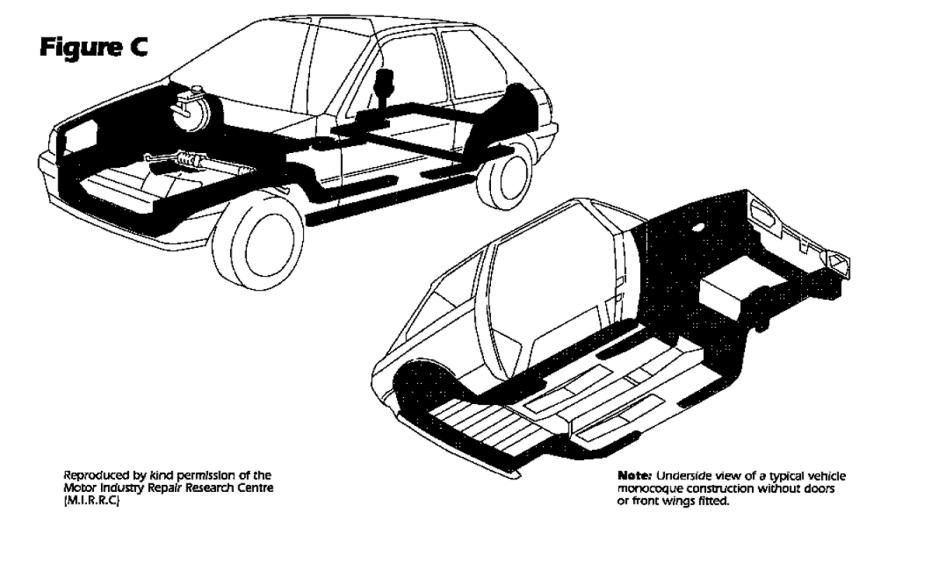
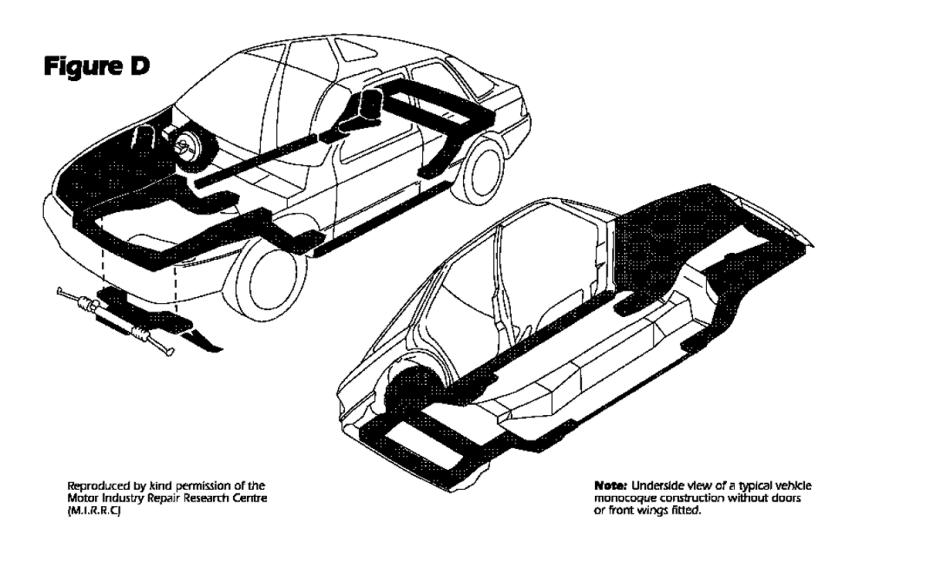
Corrosion of a particular part, such as a body sill, may be very important on one type of construction, but of less importance on another. This is shown in figures A to D where the shaded portions indicate the important load bearing parts of different typical vehicle constructions.
Prescribed Areas
To assist with the assessment of corrosion, sections titled ‘ Steering systems, Suspension general, Parking brake lever mechanism, Service manual brake control, Hydraulic/Air/Vacuum system and Seat belts’ of this manual identify the parts of the vehicle structure which are particularly important and to which particular attention must be paid during an inspection.
These are:
- The load bearing parts of the vehicle to which certain testable items (as specified in sections dealing with Steering, Brakes, Suspension and Seat belts) are mounted, and
- Any structure or panelling which is supportive to either the component mounting or its load bearing member within 30 cm of the mounting location. E.g. In the examination of a seat belt mounting on an inner sill, consideration must be given to the outer sill, door pillar, floor panel, wheel arch or any other supportive structure within 30cm of the component mounting point.
Section titled ‘General Condition of Vehicle’ of this manual deals with structural cracks, fractures, damage or corrosion not within the ‘prescribed area’.
Assessment
Having identified the important load bearing members and ‘prescribed areas’ on a vehicle, the Examiner should determine whether they are excessively corroded, firstly by visual inspection and then by finger/thumb pressure. If necessary careful scraping or light tapping of the affected areas with the Corrosion Assessment Tool is permitted. Excessively corroded metal, or metal treated with filler, emits a duller sound than does unaffected metal. It is not necessary to apply heavy impact blows or to use a sharp instrument to ‘dig’ at the structure.
Failure Criteria
Any part of a load bearing member, or load bearing panelling within a ‘prescribed area’, should be rejected if it is weakened by corrosion to the extent that:
- By finger/thumb pressure it does not feel rigid, or
- It crumbles to leave a hole, or • The Corrosion Assessment Tool: penetrates, or
- Causes the metal component to crumble or disintegrate.
- Severe distortion means distortion considered to reduce the strength of a component mounting, supporting structure, supporting panelling or load bearing member significantly or adversely affects the braking or steering.
Highly stressed components
The severity of general or local corrosion in highly stressed steering suspension components (e.g. Arms, rods, levers etc.) can be assessed by lightly tapping or scraping with the Corrosion Assessment Tool.
A small screwdriver may be used to push and probe, but only in places inaccessible to the Corrosion Assessment Tool.
A highly stressed component should be rejected if it has been:
- Seriously reduced in overall thickness by corrosion, or
- Local corrosion has resulted in even a small hole or split.
Corrosion Assessment Tool
The Corrosion Assessment Tool must be used carefully to avoid unnecessary damage. The tool comprises:
- A durable engineering plastic head for light tapping, and
- An aluminium alloy shaft with a curved ‘spade end’ for light scraping. The alloy shaft can also be used as a small lever.
Warning
The curved spade end must only be used for light scraping and not to prod and poke the vehicle structure.
Safety Precautions
Eye protection must be worn when assessing corrosion in vehicle structures and components. Any sharp edges on the Corrosion Assessment Tool should be removed.
General Guidance
Corrosion, which has not reduced the metal thickness sufficiently to weaken it, will clearly not warrant rejection. However, the Examiner should inform the vehicle presenter that corrosion has started.
Thin gauge steel pressings
In some vehicles, comparatively thin gauge steel pressings are used for certain highly stressed steering and suspension components, mountings, sub-frames and cross members.
Many of these parts have hollow sections or up facing areas in which road dirt impregnated with salt or other chemicals collects causing serious but often very localised corrosion.
In some cases where large quantities of salt are used on roads, corrosion has caused the failure of steering and suspension components within three years. Some components have been known to fail completely at one end and still be undamaged at the other.
Platform or under frame
Some vehicle types (such as VW ‘Beetle’ etc) have bodies and various mechanical parts attached to a platform or under frame, which is in the main load bearing structure. Defective body panels should only be rejected if they:
- Play an active part in directly supporting the steering, suspension, braking components or seat belt anchorage’s, or
- Are likely to adversely affect the correct functioning of the braking system or steering gear (e.g. by fouling a wheel).
Corrosion around drainage holes
Corrosion can be more prevalent in areas around drainage holes due to the ingress of moist air, dirt, road salt, etc. Therefore special attention should be paid to these areas of the important structural and testable components.
Method of Repair
It is essential that repairs to corroded areas be properly carried out. Only welding is acceptable for repairs to ‘prescribed areas’.
Suitable materials of appropriate gauge or thickness should be used for repairs so that:
- Any plating or welding extends to a sound part of a load bearing component, and
- The repair must be virtually as strong as the original structure.
So only a continuous seam weld is acceptable for patch repairs (even if the patch extends beyond the prescribed area), although spot welded joints are acceptable where they originally existed (provided the original defective panel flange has been removed).
Stitch or plug welding is acceptable as an alternative to spot welding in these cases.
Welded repairs to highly stressed components such as suspension arms, etc are not normally acceptable.
Brazing, soldering, glass fibre and body filler
These are bonding processes and are not regarded as strong enough for repairs to load bearing members although they are normally adequate for other repair work.
Brazing, bonding and riveting are only acceptable where used by the vehicle manufacturer and the standard of any such repair must be comparable to the original.
Identifying types of repair
It is sometimes difficult to distinguish between welding and brazing after the repair has been covered in paint or undersea. However, the smooth fillet of filler or a gold colouration at the edge of a joint may detect brazing.
Glass fibre, body filler, aluminium, etc, may often be detected by a difference:
- In appearance, of
- In sound when tapped, or
- By the use of a magnet.
Non-metallic vehicle structure
Plastic and Fibreglass
Plastics are becoming more common in vehicle structures. Glass reinforced plastic (GRP – also known as Fibreglass) is the most common, and variations include bodies with metal chassis or sub frames and plastic monocoque (chassis-less) construction.
Testable items mounted to plastic structures
Testable items, such as steering racks, sub frames and seat belts, are sometimes mounted directly to plastic structures which do not have metal reinforcement.
Non-metallic structures must be assessed on their merits. Look for evidence of weakness. Cracks, separation or delaminating within a ‘prescribed area’ or a component flexing on its mounting to the extent that it is clear that it is likely to work loose or break away are reasons for rejection.
Repairs to plastics
- Within a ‘prescribed area’, or
- Which affect the load bearing structure,
Should be as strong as the original part.
Structural integrity and the removal or substitution of metal panels
On a vehicle of integral construction the strength and stiffness of the whole structure may be seriously affected by any panel being removed or replaced by a panel of different material.
It is important that the Examiner considers whether the original strength and stiffness has been significantly reduced following a modification.
It is unacceptable for plastics to replace or reinforce corroded or weak metal in ‘prescribed areas’ or load bearing members or components.