Seat Belts And Supplementary Restraint Systems (SRS)
Form Number: DVT 904
Issue: 7
Origin: DVT
Review: Jan 2028
Information
Seat Belts
This inspection applies to all seat belts that are fitted i.e. mandatory and non-mandatory including disabled person’s belts and child restraints that are permanently fitted (secured by nuts, bolts etc.). If a belt is fitted, but there is no corresponding seat it is not considered to be a seat belt, for the purpose of this inspection.
Vehicles fitted with more than 8 passenger seats may be subject to a seat belt installation check. For the installation and condition check of non-mandatory seat belts fitted to minibuses, see the Heavy Vehicle Inspection manual section ‘Seat belt & anchorage points’.
Seat belt inspection also applies to some tricycles and quadricycles
1. Passenger seats
Passenger seats are those designated for normal use when the vehicle is travelling on the road. Seating arrangements only intended for use when the vehicle is stationary (e.g. settee etc in the living area of a motor caravan) are not required to have seat belts.
2. Side facing seats
Side facing seats are not required to be fitted with seat belts.
3. Occasional seats
Occasional seats that fold down when not in use are not required to be fitted with seat belts. Care must be taken in assessing whether seats are, by manufacture, intended for everyday use with the ability to be folded for extra luggage space or intended for occasional use. Seats for everyday use should not be considered as “occasional” seats.
4. Goods vehicle conversion
A goods vehicle which has been converted to a passenger vehicle specification (i.e. fitted with rear seats and side windows etc.) must comply with the relevant “passenger vehicle” requirements.
5. Seats in goods vehicles
Seats fitted to the rear of the driver’s compartment in a goods vehicle are not required to be fitted with seat belts unless the seat is the specified front passenger seat.
6. Specified front passenger seat
The “specified front passenger seat” requiring a seat belt is the seat which is:
• foremost in the vehicle and
• furthest from the drivers seat
Unless there is a fixed partition separating the passenger seat from a space in front of it which is alongside the driver’s seat, e.g. certain types of taxis, buses etc.
7. Child seat(s) retained by seat belt(s) must not be removed. A visual examination is required of only those parts of the seat belt(s) which are readily accessible.
8. Where a belt is fitted with no corresponding seat or if there is a buckle/stalk but no corresponding belt, it is NOT to be considered a seat belt for the purpose of this inspection.
9. Where practical and without the use of tools or specialist equipment, seats should be lifted to gain access to belts. Care should be taken when retrieving seat belt components from under seats.
10. Some vehicles have “Flexible seating” which allows various seating arrangements. Those seats which can be lifted without tools, specialist equipment or the need to move other seats/components should be lifted to gain access to belts.
11. ‘3 point belt’ means a seat belt which:
i. restrains the upper and lower part of the torso,
ii. includes a lap belt,
iii. is anchored at not less than three points, and
iv. is designed for use by an adult.
12. An adult harness belt comprising a lap belt and shoulder straps bearing a British Standard marking is an acceptable alternative to any of the seat belt types listed.
Exemptions
• 3 wheeled mopeds and quadricycles having an unladen weight of not more that 255 kg.
• Tip up occasional seats fitted to any vehicle.
• Rear facing (Except busses first used on or after 1 Sept 2002) or side facing seats.
• Some unbodied vehicles may have been Type Approved without seat belts. These are acceptable, provided there is evidence that they have been Type Approved in accordance with Directives 1992/61/EEC, 2002/24/EC or Regulation 168/2013EU. This information will normally appear on the manufacturer’s plate.
Note: additional seats to the side of and non sit astride seats directly behind the driver/passenger are required to be fitted with a minimum of a lap belt.
Supplementary Restraint Systems (SRS)
This inspection applies to Supplementary Restraint Systems (SRS) such as airbags, seat belt pretensioners and seat belt load limiters fitted as original equipment.

The SRS malfunction indicator lamp (MIL) may display a symbol similar to that shown here, or one depicting a person wearing a seat belt. Alternatively, the letters SRS or another symbol may be displayed.
Seat belt load limiters are used on some vehicles to minimise seat beltinflicted injury in violent collisions. This is generally achieved by releasing a little more excess belt webbing when a great deal of force is applied to the belt.
The simplest type of load limiter is a fold sewn into the belt webbing. The stitches holding the fold in place are designed to come apart when a high amount of force is applied to the belt, thereby releasing an extra bit of webbing.
A more commonly used limiter is a mechanical type, such as those which use a torsion bar in the retractor mechanism. These cannot usually be readily seen or inspected.
Seat belt pre-tensioners may be fitted to some seat belts. Once activated a warning device may display.
Method of Inspection
Seat Belts
1. Check that each seat which requires a seat belt is fitted with one of the appropriate type (see table).
2. Pull each seat belt webbing against its anchorage to see that it is properly secured to the vehicle structure.
Note: For seats with integral seat belts, it might not be possible to examine the fixing of the seat belt to the seat.
3. Examine the condition of all seat belts webbing for cuts or obvious signs of deterioration. Pay particular attention to webbing around anchorage’s, buckles and loops.
4. Examine the condition of the attachment fittings and adjusting fitting on each belt.
5. Examine flexible buckle stalks for:
• Signs of corrosion or weakness. Pull the sheaths aside, if this can be done without damage.
• ‘Waggle’ flexible buckle stalks and listen for a clicking noise indicating broken strands of cable.
6. Fasten each belt locking mechanism and try to pull the locked sections apart. On retracting seat belts, check that with the mechanism fastened and the seat unoccupied, excess webbing is wound into the retracting unit.
Note: Some types of retracting belt might need manual help before they retract.
Operate the release mechanism while pulling on the belt to check that the mechanism releases when required.
7. As far as is practicable without dismantling, check the condition of the vehicle structure around the seat belt anchorage points (i.e. within the ‘prescribed area’ see Appendix A). The floor-mounted anchorage points might need to be inspected from underneath the vehicle.
Note: While seat belts are checked at this stage, it will be time saving if the drivers seat belt is checked during stage 3 at the Shock absorber test.
Supplementary Restraint Systems (SRS)
1. As far as practicable, check that all airbags fitted as original equipment, are present and not obviously defective.
A Reason for Rejection should only be applied where there is clear evidence of an airbag being fitted as original equipment (e.g. where the vehicle has an aftermarket steering wheel with no integral airbag, and has markings indicating the presence of airbags in other locations - this may be satisfactory evidence that a driver’s air bag has been removed).
Note: Extensively Modified Vehicles.
If a vehicle has been extensively modified or converted, certain defects, such as components ‘missing where fitted as original equipment’ should not be applied, for example:
• a car converted for competition rally use must have the rear seats removed, be fitted with a roll cage and full harness seat belts, may not be fitted with components such as brake servo, power steering or airbags.
• a car converted to a stretch limousine may no longer be fitted with curtain airbags.
This exemption does not apply to vehicles with minor modifications. Therefore, a car fitted with rally style seats, body kit and a sports steering wheel would not be exempt from the requirement to have a driver’s airbag if one was fitted as standard equipment.
Vehicles modified for disabled use must be assessed on their merits. For example, it’s acceptable for the driver’s airbag to be removed for a wheelchair user, but the SRS warning lamp must not indicate a system malfunction.
2. Turn on the ignition and check the Supplementary Restraint System (SRS) malfunction indictor lamp(s) (MIL) is not indicating a fault.
3. Check the presence and condition of any seat belt load limiters and/or pretensioners fitted as original equipment.
Reason For Rejection
Seat Belts
| Reason For Rejection | Deficiency Category | ||
|---|---|---|---|
| 1 | A seat belt missing or of the wrong type | MAJOR | |
| 2 | a | a seat belt not securely fixed to the seat or to the structure of the vehicle, eg. A fixing bolt not secured. | MAJOR |
| b | for seats with seat belts attached to them; any insecure attachment of the seat to the vehicle structure. | MAJOR | |
| c | for seat with seat belts attached to them, a cracked or damaged seat frame. | MAJOR | |
| 3 | A seat belt: | ||
| a | a cut or damage sufficient to obstruct correct operation of the belt or significantly weaken the webbing, | MAJOR | |
| b | fluffing or fraying not sufficient to obstruct correct operation of the belt or which has not weakened the webbing | MINOR | |
| c | fluffing or fraying sufficient to obstruct correct operation of the belt or which has clearly weakened the webbing, | MAJOR | |
| d | stitching badly frayed, not secure, incomplete or repaired. | MAJOR | |
| 4 | An attachment fitting or adjustment fitting of a seat belt fractured or badly deteriorated. Note: Damage or deterioration of the plastic covering of a component is not a reason for rejection unless it affects the operation of the belt | MAJOR | |
| 5 | a | a corrosion or deterioration of a flexible stalk likely to lead to failure under load, | MAJOR |
| b | broken strands of a flexible stalk cable. | MAJOR | |
| 6 | a | the locking mechanism of a seat belt does not secure or release the belt as intended, | MAJOR |
| b | a retracting mechanism does not retract the webbing sufficiently to remove all the slack from the belt with the locking mechanism fastened and the seat unoccupied. Note 1: In doubtful cases, this should be checked with the seat base set in its rearmost position. Note 2: The vehicle presenter should be advised of and given the opportunity to remove any temporarily fitted device likely to cause failure under this reason for rejection before notification of refusal is issued. | MAJOR | |
| 7 | Deliberate modification which significantly reduces the original strength, excessive corrosion, severe distortion, a fracture or an inadequate repair of a load bearing member or its supporting structure or panelling within 30 cm of a seat belt anchorage. Note: With a seat belt attached to a seat frame this reason for rejection will apply to all seat mounting points. | MAJOR |
Supplementary Restraint Systems (SRS)
| Reason For Rejection | Deficiency Category | ||
|---|---|---|---|
| 1 | An airbag obviously missing (where fitted as original equipment) or defective. (See SRS section above for guidance) Note: A passenger airbag that has been turned off is not a Reason for Rejection. | MAJOR | |
| 2 | A Supplementary Restraint Systems (SRS) malfunction indicator lamp indicating a system malfunction. | MAJOR | |
| 3 | A | A seat belt load limiter or pretensioner obviously missing where fitted as original equipment | MAJOR |
| b | a seat belt pretensioner or a ‘folded webbing’ type load limiter obviously deployed. | MAJOR |
Seat Belt Requirements for Vehicles First Used Before 1 April 1987 (or in the case of Minibuses, Motor Caravans and Ambulances 1 October 1990)
| Vehicle Description | Driver’s and specified front passenger’s seat (see Note 1) | Centre front seat | Forward facing rear seats |
|---|---|---|---|
3-wheeled vehicles with an unladen weight over 410 kg first used on or after 1 January 1965,* OR with an unladen weight over 225 kg if first used on or after 1 September 1970.* *Except vehicles less then 410 kg unladen, equipped with a driving seat of a type requiring the driver to sit astride it, and constructed or assembled by a person not ordinarily engaged in the trade or business of manufacturing vehicles of this type. | A. Vehicles first used before 1 April 1982: A belt which restraint the upper part of the body (but need not include a lap belt) for each seat. B. Vehicles first used after 1 April 1982: A 3 point (lap/diagonal) belt (See Note 2 below) | No requirement | No requirement |
Passenger and dual purpose vehicles with no more than 8 passenger seats With 4 or more wheels first used on or after 1 January 1965 Except Quadricycles having an unladen weight not more than 255kg | As Above | No requirement | No requirement |
| Minibuses (9-12 passenger seats inclusive), motor caravans and ambulances first used on or after 1 January 1965 not exceeding 2540kgs unladen | As Above | No requirement | No requirement |
Goods vehicles and living vans - with an unladen weight not exceeding 1525 kg, - first used on or after 1 April 1967. or - with a design gross weight not exceeding 3500 kg, | As Above | No requirement | No requirement |
Seat Belt Requirements for Vehicles First Used After 31 March 1987 (or in the case of Minibuses, Motor Caravans and Ambulances 30 September 1990)
| Vehicle Description | Driver’s and specified front passenger’s seat | Centre front seat | Forward facing rear seats |
|---|---|---|---|
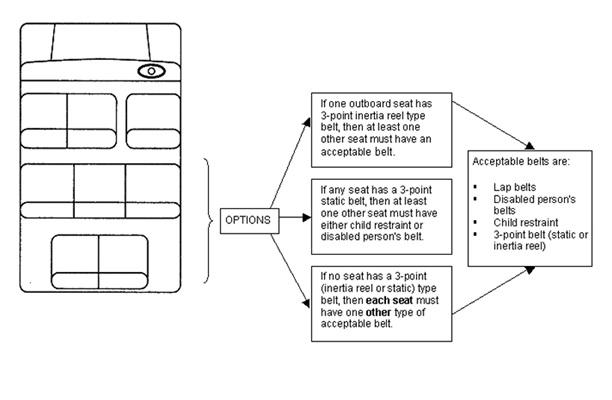
Passenger vehicles and dual purpose vehicles with not more than 8 passenger seats Except Quadricycles first used on or after 17 June 1999. 3 wheeled - With an unladen weight of 255kg or less 3 wheeled - First used before 17 June 1999 With an unladen weight over 255kg but less than 410kg - Equipped with a driving seat of a type requiring the driver to sit astride it, and - Constructed or assembled by a person not ordinarily engaged in the trade or business of manufacturing vehicles of this type NOTE: For quadricycles and tricycles used on or after 17 June 1999, see item below. | 3 point belts for each seat. (see note 2 & 3) | 3 point belt, lap belt or a disabled person’s belt. | 1. Vehicles with not more than 2 rear seats: Either A. A 3 point inertia reel belt for at least one seat; Or B. A 3 point belt, lap belt, disabled person’s belt or child restraint for each seat Or Vehicles with more than 2 rear seats: Either I. A 3 point inertia reel belt on an outboard seat and a 3 point static or inertia reel belt, lap belt, disabled persons belt or child restraint for at least one other seat; Or II. A static 3 point belt for one seat and a disabled person’s belt or child restraint for at least one other seat; or III. A 3 point belt, lap belt, disabled person’s belt or child restraint for each seat. See additional information |
| Motor caravans and Ambulances with a design gross weight NOT exceeding 3500kg | 3 point belts for each seat. (see note 2 & 3) | 3 point belt, lap belt or a disabled person’s belt. | No requirement |
| Minibuses with a design gross weight NOT exceeding 3500kg Used before 1 September 2002 | 3 point belts for each seat. (see note 2 & 3) | 3 point belt, lap belt or a disabled person’s belt. | No requirement |
| Buses, with a design gross weight NOT exceeding 3500kg used on or after 1 September 2002 | 3 point belts for each seat. (see note 2 & 3) | 3 point belt, lap belt or a disabled person’s belt. | A 3 point inertia reel belt, disabled persons belt or child restraint. A retractable lap belt (on rearward facing seats only) |
| Goods Vehicle & living van (with a design gross weight not exceeding 3500kg) | 3 point belts for each seat. (see note 2 & 3) | 3 point belt, lap belt or a disabled person’s belt. | No requirement |
Tricycles and quadricycles having an unladen weight more that 255kg and first used on or after 17th June 1999. See exemptions. | 3 point lap and diagonal belt (may be static or inertia), harness belt or disabled persons belt. | A lap belt, 3 point lap and diagonal belt (may be static or inertia), harness belt or disabled persons belt. | A lap belt, 3 point lap and diagonal belt (may be static or inertia), harness belt, disabled persons belt or child restraint. (this includes outboard forward facing seats fitted to un bodied tricycles) |
NOTE 1: Specified front passenger seat
The “specified front passenger seat” requiring a seat belt is the seat which is:
• foremost in the vehicle and
• furthest from the drivers seat
Unless there is a fixed partition separating the passenger seat from a space in front of it which is alongside the driver’s seat, e.g. certain types of taxis, buses etc.
NOTE 2: ‘3 point belt’ means a seat belt which:
v. restrains the upper and lower part of the torso,
vi. includes a lap belt,
vii. is anchored at not less than three points, and
viii. is designed for use by an adult.
NOTE 3: An adult harness belt comprising a lap belt and shoulder straps bearing a British Standard marking is an acceptable alternative to any of the seat belt types listed.
(Additional Information : Forward Facing Rear Seats)
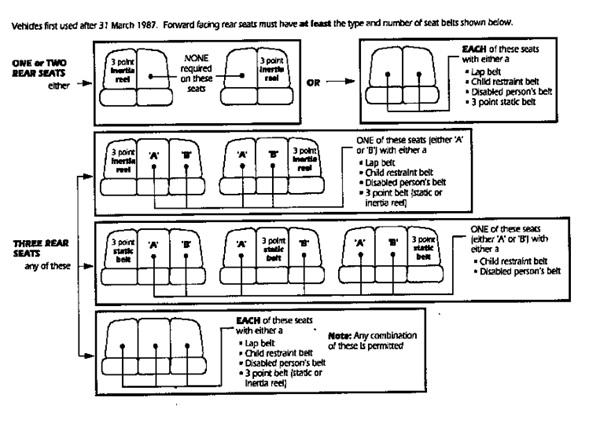
More Than Three Rear Seats
Note:
1. Rear facing (Except busses first used on or after 1 Sept 2002) or side facing seats are not required to be fitted with seat belts
2. Outboard seats are seats closest to the vehicle sides
3. Occasional seats that fold when not in use, fitted in the rear of extended limousines, are not required to be fitted with seat belts.
4. Seats fitted to the rear of the driver’s compartment in a goods vehicle do not require to be fitted with seat belts (unless the seat is the specified passenger seat).
5. A goods vehicle (e.g. a car derived van) which has been converted to a passenger vehicle specification (i.e. fitted with rear seats and side windows etc) is required to comply with the passenger vehicle requirements