Headlamps Aim
Form Number: DVT 897
Issue: 6
Origin: DVT
Review: Jan 2028
Information
This inspection applies to all obligatory headlamps, and optional (additional) dip beam headlamps.
Type of headlamp
The aim of headlamps must be checked on main or dipped beam according to their type.
A flat top or other alternative headlamp dipped beam pattern (not being one of the examples) is acceptable providing all of the beam upper edge, including any “peak” is contained within the appropriate tolerance band.
The method of inspection involves the use of beam checking equipment with a collecting lens.
Masks or converter kits
Right hand dip headlamps can be temporarily altered for use in the UK by fitting masks or converter kits which remove the beam ‘kick-up’ to the right. Headlamp altered in this way is not a reason for rejection, if:
a. The headlamp aim is not rejected for the reasons listed under European ‘E’ beam headlamp (except that the top of the beam image will be a straight line).
b. The light output is not unduly reduced – not usually a problem with commercially produced kits.
c. The mask or converter is securely attached.
Driver’s beam aim controls
Where these are fitted the beam aim should be tested without altering the controls setting except where this would result in failure for beam aim being too low. In such cases the beam aim should be re-checked with the control set at its ‘highest’ position.
When testing headlamps with complex lens systems
When testing headlamps with complex lens systems i.e. those that have more than one lamp behind a single lens, it is essential that the headlamp aim test equipment is aligned exactly on the centre of the dipped beam pocket.
If when carrying out a normal test a clearly defined headlamp pattern cannot be seen, it will be necessary to move the vehicle closer to the test equipment.
It is essential that the vehicle headlamp and test equipment are as close together as possible, otherwise the whole of the beam pattern may not be visible.
Method Of Inspection
To check headlamp aim
1. Position the vehicle on the designated headlamp aim standing area.
2. Follow the headlamp tester manufacturer’s user manual instructions, and
a. align the headlamp aim equipment with the longitudinal axis of the vehicle,
b. align the centre of the collecting lens with the centre of the headlamp under test.
3. With the customer sitting in the driving seat, switch on the headlamps to the beam on which the headlamp is to be checked.
Note: When checking headlamp aim on vehicles with hydropneumatic suspension systems, it is necessary to have the engine idling.
Note: An increasing number of modern vehicles are fitted with headlamp systems that require the engine to be idling in order to activate their headlamp alignment system and / or needing the steering in the straight ahead position to align the head lamps. Therefore before any vehicle is refused for incorrect headlamp aim, they should have the headlamp aim checked with the engine idling and the steering in the straight ahead position.
4. Determine the appropriate headlamp type and its aim.
Note: Old vehicles (approx pre 1960) headlamps beam image may not conform to either of the types of lamps described in this section or they may not be bright enough to activate the headlamp equipment. In such cases check the alignment of the lights against a vertical surface. Position the vehicle in front of the vertical surface, at a distance of 25feet from the surface the headlamp image should be below 3feet 6inches.
5. When the examiner identifies the type of headlamp, and selects the appropriate testing program, the beam testing equipment will electronically record the test values and display these for each headlamp. When this information is transferred to the test lane, these test values will be automatically compared with the limit values and the headlamp aim passed or failed.
European ‘E’ Beam Headlamp (Checked On Dipped Beam)
European type headlamp – Characteristics
a. An asymmetric dipped beam pattern with:
• a distinctive horizontal cut-off on the right, and
• a 15 degree wedge of light above the horizontal (the ‘Kick up’) towards the left.
b. A lens with one or more asymmetric stepped patterns moulded in the glass
c. A lens may carry:
• a European approval mark – a circle containing an ‘E’ and a number, or
• a rectangle containing an ‘e’, and a number.
The European approval mark should incorporate a single or double-headed arrow.
A dipped beam is denoted by either:
• a capital letter ‘C’ above a capital ‘E’.
• a capital letter ‘C’ above an ‘e’.
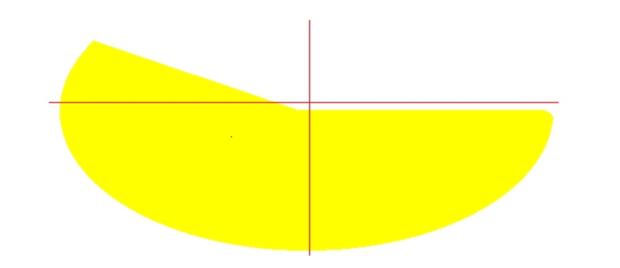
Note: Setting ‘E’ Beam Headlamp Aim
Repairs or adjustment must not be carried out during a test.
These dip-beam headlamps should be set to aim downwards the amount shown on a marking which is either close to the vehicle manufacturer’s plate or the headlamp.
For vehicles without a marking, the downward aim should be set to:
• -1.3%, if the headlamp centre is not more than 850 mm from the ground.
• -2.0%, if the headlamp centre is more than 850 mm from the ground.
| Reason For Rejection | Deficiency Category | |
|---|---|---|
| 1 | The beam image ‘kick-up’ is to the offside | MAJOR |
| 2 | Projected beam image obviously incorrect, e.g. where the headlamp bulb is incorrectly fitted or the reflector is seriously corroded. | MAJOR |
| 3 | For headlamps with centres not more than 850 mm from the ground the beam image horizontal cut-off is not between the horizontal -0.5% and -2% lines. | MAJOR |
| 4 | For headlamps with centres more than 850 mm from the ground, the beam image horizontal cut-off is not between the horizontal -1.25% and -2.75% lines. | MAJOR |
British American Headlamps (Checked On Main Beam)
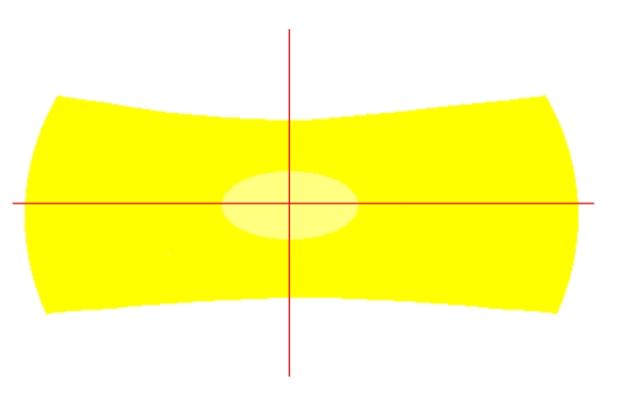
British American type (checked on main beam) - Characteristics:
a. Headlamps tested on main beam have a symmetrical main beam pattern with a central area of maximum intensity (hot spot)
b. This type of lamp generally has a circular lens which may be marked with a figure 1 followed by an arrow indicating the direction of a dip.
| Reason For Rejection | Deficiency Category | |
|---|---|---|
| 1 | The ‘hot spot’ centre is above the horizontal 0% line. | MAJOR |
| 2 | For headlamps whose centre is not more than 850 mm from the ground the ‘hot spot’ centre is below the horizontal -2% line. | MAJOR |
| 3 | For headlamps whose centre is more than 850 mm from the ground, the ‘hot spot’ centre is below the horizontal 2.75% line. | MAJOR |
| 4 | When dipped the brightest part of the image does not move downwards or downwards to the nearside. | MAJOR |
| 5 | The ‘hot spot’ centre is to the right of the vertical 0% line, or to the left of the vertical 2% line. | MAJOR |
| 6 | Projected beam image obviously incorrect, e.g. where the headlamp bulb is incorrectly fitted or the reflector is seriously corroded. | MAJOR |
British American Type (Checked On Dipped Beam)
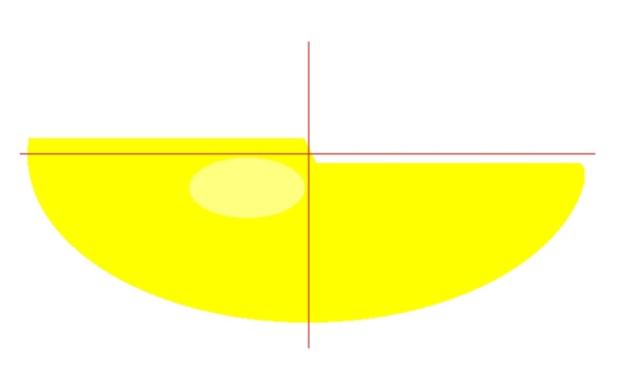
British American type (checked on dipped beam) – Characteristics
a. An asymmetric dipped beam pattern with an area of high intensity intended to be directed along the nearside of the road.
b. A circular lens marked with the figure 2 which may also have an arrow showing the direction of dip.
| Reason For Rejection | Deficiency Category | |
|---|---|---|
| 1 | The upper edge of the ‘hot spot’ is above the horizontal 0% line. | MAJOR |
| 2 | The upper edge of the ‘hot spot’ is below the horizontal -2.75% line | MAJOR |
| 3 | The right hand edge of the ‘hot spot’ is: to the right of the vertical 0% line or to the left of the vertical -2% line. | MAJOR |
| 4 | The raised portion of the (beam) image is to the right/offside of the centre line. | MAJOR |
| 5 | Projected beam image obviously incorrect, e.g. where the headlamp bulb is incorrectly fitted or the reflector is seriously corroded. | MAJOR |