Graduated Driver Licensing – FAQs
A list of Frequently Asked Questions (FAQs) on the introduction of Graduated Driver Licensing.
What is Graduated Driver Licensing (GDL)?
GDL is a phased approach to driver licensing designed to improve road safety for new drivers, particularly young drivers aged 17-23 who are disproportionately represented in fatal road traffic collisions. It introduces a longer protection period of two years and requirements such as a supervised mandatory minimum learning period of 6 months, limits on night-time driving, and passenger numbers.
Fundamental goal of GDL
The fundamental goal of learning to drive and the licensing process should be to create drivers and motorcyclists who are safe, and not just technically competent, by the time they are permitted to drive or ride unsupervised. GDL plans to achieve this through a structured approach to learning to drive, including the completion of a Programme of Training and Logbook. This will better prepare drivers for both the driving test and initial post-test driving period by helping learners understand how human factors such as their attitude, personality, behaviour and feelings affect their driving style.
Why is GDL being introduced in Northern Ireland?
In 2024, there were 164 casualties (killed or seriously injured) from collisions where a car driver aged 17-23 was responsible. This age group of drivers accounts for 24% of fatal or serious collisions despite holding just 8% of licences. Also in 2024, there were 12 casualties (killed or seriously injured) from collisions where a motorcyclist aged 17-23 was responsible.
GDL aims to reduce these figures by allowing new drivers to gain experience and skills gradually in lower-risk conditions.
Behind these figures are too many shattered lives as loved ones who set off on an everyday journey suffer lifechanging injuries or never go back home to their family and friends.
What evidence supports GDL’s effectiveness?
Transport Research Laboratory (TRL) reports that GDL schemes reduce collisions involving young drivers by between 5-40% depending on the strength of the GDL components being implemented. Countries like Australia, Canada, Norway, Sweden, Finland and parts of the US have seen significant improvements in road safety after adopting GDL.
What protections will apply under GDL?
Key measures include:
A mandatory minimum learning period before testing (MMLP). Learner drivers cannot sit their practical test until at least six months after the date their provisional driving licence becomes valid (this will not apply to motorcyclists). Promotes a cultural shift in learning to drive by placing greater emphasis on comprehensive driver education, to complement practical learning in preparation for the driving test. The MMLP promotes a structured learning approach, including:
- Completion of training modules to develop positive behavioural and attitudinal learning, and
- Practical driving experience to consolidate module learning and develop driving skills.
- A Programme of Training that details the learning required to become a safe driver. This must be completed and recorded in a Logbook before a learner driver can undertake their practical driving test. The Programme of Training and completion of the Logbook is delivered through a mobile GDL App and is also available as a web browser option.
- Post-test protections such as:
- Longer protection period increased from 12 months to 24 months. The current 12-month protection period, where a new driver must display R plates, will be extended to a 24 month ‘new driver’ period. This will require new drivers to display a distinguishing mark (R plate) on the vehicle for two years after receiving a full licence.
- Night-time passenger restrictions for new drivers under 24, for the first six months after passing their test (drivers only): no more than one passenger aged between 14-20 years between 23:00 and 06:00 (exemptions apply for immediate family members). This will not apply to motorcyclists.
Will there be any exemptions in place?
Yes, there will be some limited exemptions in place:
- MMLP – Learners who can evidence their entitlement to Carers Allowance will be exempt from the six-month Mandatory Minimum Learning Period. This exemption recognises that a carer may be the main support for a vulnerable individual who might benefit from the learner acquiring a driving licence quickly and will help maintain or minimise any potential disruption to their care. A carer availing of this exemption will still have to complete the Programme of Training and evidence completion in the learner Logbook before they may sit the practical test.
- Passenger Restriction – passenger restrictions will not apply for immediate family members. Additionally, the passenger restrictions will not apply if there is an accompanying person in the front seat who is aged 21 years or older, and who has held a full driving licence for three years.
The Logbook
The digital solution for the Programme of Training and Logbook has been designed to feed information to the DVA Booking system to allow a learner to book their practical test once all elements of the learning process have been completed, which include:
- Six-month Mandatory Minimum Learning Period;
- The Theory Test;
- Completion of the new GDL Programme of Training and Logbook; and
- For learner riders only, Compulsory Basic Training (CBT), where required.
Will GDL unfairly penalise young drivers?
GDL is not about limiting independence, it is about saving lives. Protections are temporary and designed to reduce risk during the highest-risk period for new drivers.
How will GDL be enforced?
Enforcement will be undertaken by the PSNI through the legislative powers provided under the GDL framework, supported by communication and education from the Department and approved instructors. However, we expect that, where applicable, parents and guardians and young people themselves will be the main enforcers of the new measures.
What penalties will be applied to drivers in breach of GDL conditions?
GDL will have specific offences and penalties:
- Failure to display the specified distinguishing mark (‘R’ plate) during the two-year new driver period. Potential £1,000 fine alongside three penalty points
- Driving with an unauthorised passenger in the car during first six months after passing test. Potential £1,000 fine alongside three penalty points
- Failure of driver or owner of vehicle or other person required to do so, to give information for purposes of identification to police. Where the driver of a vehicle is alleged to be guilty of an offence under Article 19AB(8) (breach of any of the specified restrictions). Potential £1,000 fine alongside three penalty points
The Road Traffic (New Drivers) (Northern Ireland) Order 1998 mandates a two-year probationary period for new drivers. During that two-year period, if a new driver accumulates six or more penalty points their license will be revoked and they will require re-testing.
Will GDL affect rural communities?
Existing research suggests that GDL can have a positive impact on rural communities by reducing collisions involving young drivers. In 2024, 71% of people killed or seriously injured from collisions involving a driver aged 17-23 were on rural roads. Rural communities are severely affected by the tragic loss and consequences associated with serious road traffic collisions. We recognise rural drivers face unique challenges. The scheme has been designed to minimise inconvenience while prioritising safety.
What impact will GDL have on insurance costs?
Evidence suggests GDL can reduce collision risk, which may lead to lower premiums for new young drivers over time.
When will GDL be introduced and how will people be informed?
GDL was introduced on 1 October 2026. A new practical driving test will be introduced on 1April 2027 (six months after GDL was introduced to accommodate the mandatory minimum learning period). This is the most significant reform to driver licensing and testing in almost 70 years.
The Department launched a public information campaign about GDL on 17 August 2026. The campaign highlights the key safety messages and risk factors that underpin GDL. It raises awareness of the need for change and GDL’s contribution to improving road safety. Advertising took place across TV/video-on-demand, radio, outdoor advertising, and social media and digital channels.
Why not focus on other measures like education or stricter drink-driving laws?
GDL complements existing and prospective measures. Education and enforcement remain vital, but GDL adds a proven layer of protection during the most vulnerable stage of driving.
Introduction of a passenger carrying restriction
These restrictions apply to newly qualified drivers only, they do not include motorcyclists. There is compelling evidence of the heightened collision risk when new young drivers carry teenage passengers.
New drivers, up to age 24, will be restricted to carrying one passenger for the initial six months post-test period between the hours of 23:00 and 06:00 hours. This will apply to passengers aged 14-20, with an exemption for immediate family members. Additionally, the passenger restrictions will not apply if there is an accompanying person in the front seat who is aged 21 years or older, and who has held a full driving licence for three years.
Will GDL increase the cost of learning to drive?
The main cost in learning to drive is the cost of instruction. With the introduction of GDL learner drivers may still choose to learn to drive with a supervising driver, an approved driving/motorcycle instructor or a combination of both. These costs will not be affected by the introduction of GDL.
The cost of applying for a practical driving test will also not change with the introduction of GDL. However, there will be a cost of £17 to the learner for the use of the app for the Category A (motorcycles) Programme of Training and Logbook and Category B (cars) Programme of Training and Logbook.
What will the new ‘R’ plate look like?
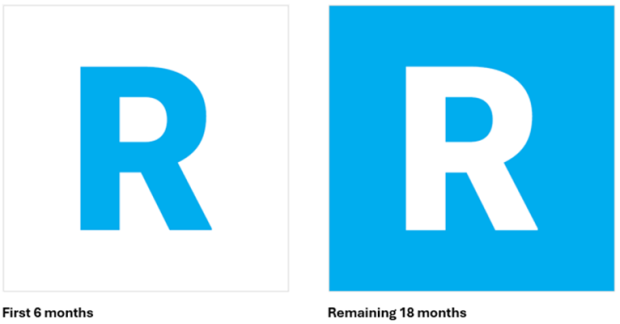
GDL will require new drivers to display an ‘R’ plate for a period of two years after passing their test, which will be split into:
- Initial six months post-test: includes age-related passenger and night-time restrictions, indicated by a blue ‘R’ plate on a white background; and,
- Remaining 18 months post-test: Idicated by a white ‘R’ plate on a blue background.
- The longer new driver period of two-years is a proven additional layer of protection during the period when new drivers, particularly new young drivers, are most at risk. Although newly qualified drivers can drive up to posted speeds under GDL, displaying the ‘R’ plate should help deter high risk behaviour and inform other road users of the relative inexperience of the driver.
- The new ‘R’ plate also aligns with the two-year probationary period in the Road Traffic (New Drivers) (NI) Order 1998 which provides for the revocation of a driving licence during the probationary period if a new driver receives an accumulation of six or more penalty points. The first part of the new ‘R’ plate will also help inform enforcement agencies that the driver is within the passenger restriction period during their first six months post-test.
Please refer to summary table below for specific ‘R’ Plate scenarios based on Provisional Licence entitlement and the date you have passed your test:
Period | Scenario | R Plate Requirement |
|---|---|---|
| If you pass your driving test before 1 October 2026 | You must display the amber ‘R’ plates and remain subject to the current restrictions until your restricted period ends. |
| 2(a) From 1 October 2026 | If your provisional entitlement began before 1 October 2026 and you pass your driving test between 1 October 2026 and 31 March 2027 | You must display the amber ‘R’ plates and remain subject to the current restrictions until your restricted period ends. |
| 2(b) From 1 October 2026 | If your provisional entitlement began before 1 October 2026 but you choose to complete GDL and take your test after 1 April 2027 | You will be subject to the GDL Scheme and after passing your test after 1 April 2027, you must display the new blue ‘R’ on a white background for 6 months, followed by the new white ‘R’ on a blue background until your restricted period ends. |
| 3(a) After 1 October 2026 everyone will be subject to GDL | If your provisional entitlement begins after 1 October 2026 | You will be subject to the GDL Scheme and must display the new blue ‘R’ on a white background for 6 months, followed by the new white ‘R’ on a blue background until your restricted period ends. |
| 3(b) Between 1 October 2026 to 31 March 2027 (Transitional Period) | If your provisional entitlement begins after 1 October 2026 and you are entitled to exemptions from MMLP | You will take the current practical test but may train at higher speeds. If you pass your test before 31 March 2027, you must display the new blue ‘R’ on a white background for 6 months, followed by the new white ‘R’ on a blue background until your restricted period ends. |
Does my Category F (Tractor) or AM (Moped) entitlement count towards my six-month MMLP?
No, your MMLP will start from the first date of your Category B (Motorcar) Provisional entitlement. The earliest date of this entitlement is normally your 17th birthday.
Will the introduction of GDL affect current Learner Drivers?
If your provisional licence entitlement (Category A or B) commenced before 1 October 2026, you will continue to learn to drive in the same way as you currently do and you will be able to take the current practical driving test up to and including 31 March 2027. From 1 April 2027, all learners will be required to have completed the GDL Programme of Training and Logbook before they will be able to book the practical driving test.
Transitional Arrangements – 1st October 2026 – 31st March 2027
Transitional arrangements for learners whose provisional licence entitlement to drive a category B vehicle commenced before 1 October 2026 are set out in the Road Traffic (Amendment) Act 2016. While there will be a period during which newly qualified drivers are subject to different post-test requirements, this is a necessary consequence of the transition from one driver licensing system to another.
- From 1st October 2026, those drivers who have passed a category B test prior to that date should continue to display the current (amber) R plate and remain subject to a 45mph speed limit for 12 months, up until the end of their restricted period. This will also apply to new A1 category motorcycle riders.
- Learners with a provisional licence entitlement to drive a category B vehicle that commenced before 1st October 2026 and who pass the practical driving test during the transitional period, that is before 1st April 2027, will also be subject to existing restrictions, ie. a 45mph speed limit and display of an amber R plate for 12 months. This will also apply to new A1 category motorcycle riders.
- Learners with a provisional licence entitlement to drive a category B vehicle that commenced after 1st October 2026 and who are exempt from the MMLP and subsequently pass the practical driving test during the transitional period, that is before 1st April 2027, will be subject to GDL, ie. can drive up to posted speeds and display a blue R plate on a white background for 6 months followed by a white R on a blue background for the remaining 18 months of their two-year restricted period. As motorcyclists will not be subject to the MMLP, this will also apply to new A1, A2 and A category motorcyclists who pass their practical test within the transitional period.
Who can sign off the GDL Programme of Training and Logbook?
The learner is responsible for the completion of the Programme of Training and Logbook, which can then be signed off by an Approved Instructor/Supervising Driver.
Changes to the Practical Driving Test:
The driving test will change to incorporate elements linked to GDL, such as:
- Independent driving section extended to approximately 20 minutes;
- Introduction of sat nav use;
- Show me, tell me questions asked/answered on the move;
The purpose of the test remains to ensure candidates are safe, competent and considerate drivers. The overall standard for passing the Practical Driving Test will remain unchanged.
Does GDL apply to new motorcyclists?
Yes. GDL will apply to new category A1, A2 and A learner motorcyclists from 1 October 2026.
Learner motorcyclists already complete Compulsory Basic Training. Why do they need to also do GDL?
Learning to ride a motorcycle can be enhanced by measures such as the Programme of Training and Logbook, motorway lessons when accompanied by an Approved Motorcycle Instructor (AMI) and the removal of the 45mph limit.
Will the 6-month mandatory minimum learner period apply to learner motorcyclists/riders?
Motorcyclists will not be subject to the Mandatory Minimum Learning Period as they must complete Compulsory Basic Training before undertaking the training introduced by GDL.
Will motorcyclists have to display the R plate?
Newly qualified riders will be required to display the new two-part ‘R’ plate for two years. Passenger carrying restrictions will not apply to newly qualified riders.